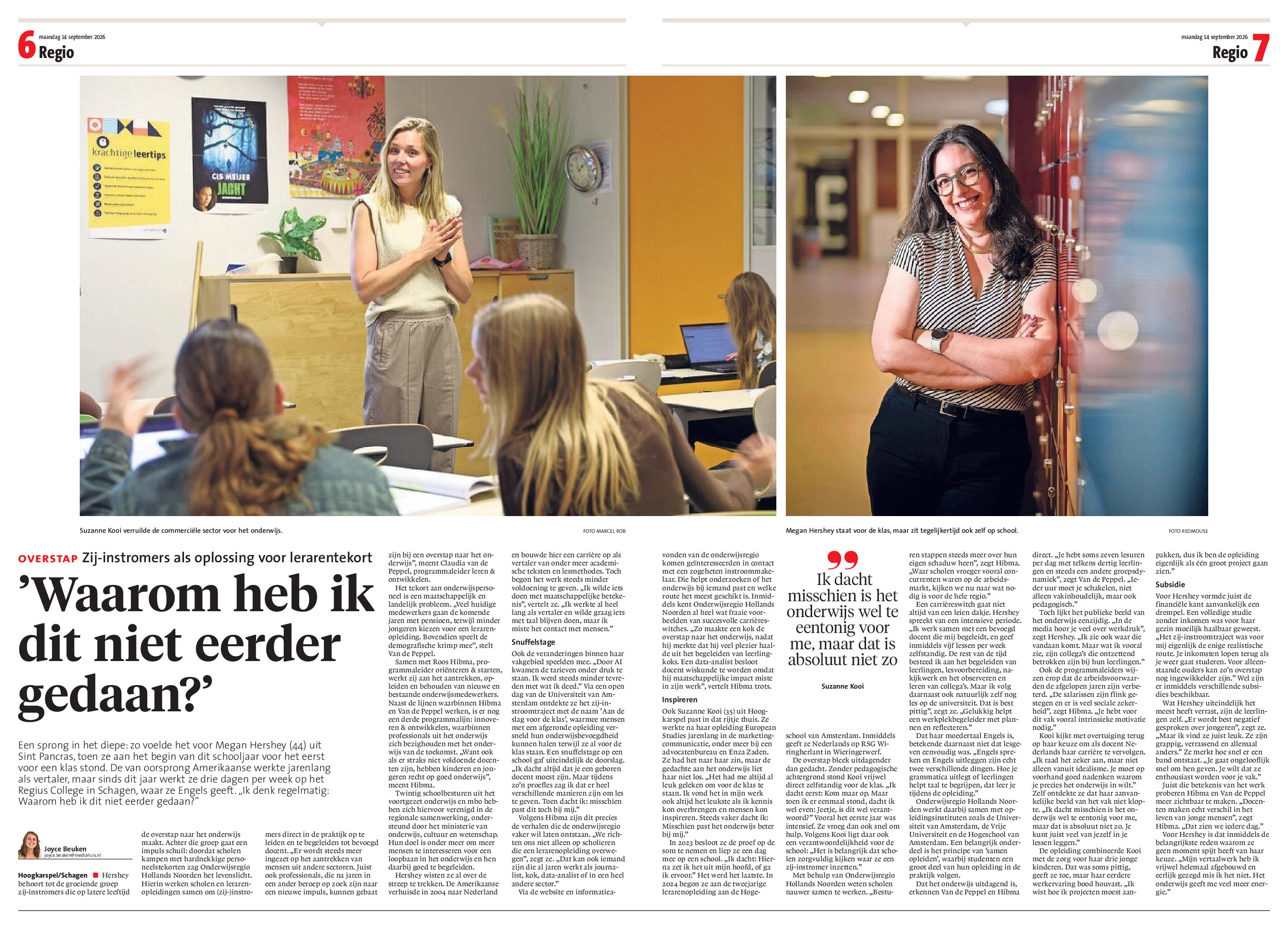
Hoogkarspel/Schagen: A leap in the dark: that is how it felt for Megan Hershey (44) from Sint Pancras when she stood in front of a class for the first time at the start of this school year. Originally from America, she worked as a translator for years, but since this year she has been working three days a week at the Regius College in Schagen, where she teaches English. „I regularly think: why didn't I do this sooner?”
Hershey belongs to the growing group of career switchers who move into education at a later age. Behind this group lies an initiative: because schools are struggling with persistent staff shortages, Onderwijsregio Hollands Noorden came into being. Within this framework, schools and teacher training institutions collaborate to train and mentor (career-switching) entrants directly in practice to become qualified teachers. „Increasingly, efforts are being made to attract people from other sectors. Especially professionals who, after years in another profession, are looking for a new impetus can benefit from a move into education,” believes Claudia van de Peppel, learning & development programme manager.
The shortage of teaching staff is a societal and national problem. „Many current employees will retire in the coming years, while fewer young people are choosing teacher training. Moreover, demographic decline plays a part,” states Van de Peppel.
Together with Roos Hibma, programme leader for orientation & starting, she is working on attracting, training and retaining new and existing educational staff. Alongside the areas in which Hibma and Van de Peppel operate, there is a third programme stream: innovating & developing, in which education professionals focus on the education of the future. „Because even if there are not enough teachers in the near future, children and young people are entitled to a good education,” Hibma believes.
Twenty secondary and further education school boards have joined forces for this purpose in a regional partnership, supported by the Ministry of Education, Culture and Science. Their goals include generating more interest in a career in education and providing sound guidance to those individuals.
They had already managed to persuade Hershey. The American moved to the Netherlands in 2004 and built up a career here as a translator of academic texts and teaching methods, among other things. Yet the work began to feel less and less fulfilling. „I wanted to do something with social significance,” she says. „I had been working as a translator for a very long time and wanted to keep doing something with language, but I missed contact with people.”
work experience placement
Changes within her field also played a part. „AI put pressure on the rates. I became less and less satisfied with what I was doing.” Through an open day at the University of Amsterdam, she discovered the career-changer pathway called ’Get to work in the classroom’ („Aan de slag voor de klas”), which allows people with a completed degree to obtain their teaching qualification on an accelerated basis whilst already teaching in the classroom. A taster placement at a school ultimately clinched it. "I always thought you had to be a born teacher. But during such a trial lesson I saw that there are very different ways of teaching. Then I thought: perhaps this suits me after all."
According to Hibma, these are precisely the stories that the educational region wants to generate more often. „We aren't just focusing on pupils who are considering teacher training,” she says. „That could also be someone who has been working for years as a journalist, chef, data analyst or in a completely different sector.”
Through the website and information evenings of the education region, interested people come into contact with a so-called career changer broker. They help investigate whether education suits someone and which route is most suitable.
By now, Education Region Hollands Noorden already features quite a few fine examples of successful career switches. „For instance, a chef made the transition to education after noticing that he got a lot of enjoyment out of mentoring trainee chefs. A data analyst decided to become a maths teacher because he missed social impact in his work,” Hibma recounts proudly.
Inspire
Suzanne Kooi (35) from Hoogkarspel also fits into that category. After completing her European Studies degree, she worked in marketing communications for years, including at a law firm and Enza Zaden. She enjoyed it, but the thought of teaching would not let go. „I had always fancied standing in front of a class. In my work, I also always found it the best part when I could pass on knowledge and inspire people. More and more often I thought: Perhaps teaching suits me better.”
In 2023, she decided to put it to the test and shadowed at a school for a day. „I thought: After this, I’ll either put it out of my mind, or I’ll go for it.” It turned out to be the latter. In 2024, she started the two-year teacher training programme at the Amsterdam University of Applied Sciences. She now teaches Dutch at RSG Wiringherlant in Wieringerwerf.
The transition proved more challenging than thought. Without an educational background, Kooi found herself standing independently in front of the class almost immediately. „At first I thought: Bring it on. But once I was actually standing there, I did think for a moment: Blimey, is this even responsible?” Especially the first year was intensive. She therefore quickly asked for help. According to Kooi, there is also a responsibility there for the school: „It is important that schools carefully consider where they deploy a career-changer.”
Using Education Region Hollands Noorden, schools are managing to work more closely together. „Boards are increasingly stepping over their own shadow,” says Hibma. „Whereas schools used to be primarily competitors in the labour market, we are now looking at what is needed for the entire region.”
A career switch does not always go swimmingly. Hershey speaks of an intensive period. „I work together with a qualified teacher who mentors me, and I now teach five lessons a week independently. The rest of the time I spend on mentoring pupils, lesson preparation, marking work, and observing and learning from colleagues. But of course I also still take classes myself at university. That is quite tough,” she says. „Fortunately, a workplace mentor helps with planning and reflection.”
Moreover, the fact that English was her native language did not mean that teaching was simple. „Speaking English and explaining English are truly two different things. How you explain grammar or help students understand language, that is what you learn during your training.”
Hollands Noorden Education Region is collaborating with training institutes such as the University of Amsterdam, Vrije Universiteit Amsterdam and Amsterdam University of Applied Sciences. An important component is the principle of ’joint training’, whereby students complete a large part of their training in practice.
That education is challenging is something Van de Peppel and Hibma readily acknowledge. „You sometimes have seven lessons a day, each with thirty pupils and a constantly changing group dynamic,” says Van de Peppel. „Every hour you have to switch gears, not just in terms of subject matter, but also pedagogically.”
Yet the public image of education seems one-sided. „You hear a lot about workload in the media,” says Hershey. „I also see where that comes from. But what I mainly see are colleagues who are incredibly dedicated to their students.”
The programme leaders also point out that the terms of employment have improved in recent years. „Salaries have risen considerably and there is a high level of social security,” says Hibma. „For this profession, you mainly need intrinsic motivation.”
Kooi looks back with conviction on her choice to continue her career as a Dutch teacher. „I certainly recommend it, but not just out of idealism. You need to think carefully beforehand about why exactly you want to go into teaching.” She discovered for herself that her initial perception of the profession was incorrect. „I thought teaching might be too monotonous for me, but that is definitely not the case. In fact, you can put a lot of yourself into your lessons.”
The training combined Kooi with caring for her three young children. That was sometimes tough, she admits, but her previous work experience provided a firm footing. „I knew how to tackle projects, so I actually started to view the training as one big project.”
Grant
For Hershey, it was specifically the financial side that initially presented a barrier. A full-time degree without an income would have been difficult for her family to manage. „The career-switch teacher training pathway was really the only realistic route for me. Your income drops when you go back to studying. For single parents, such a transition can be even more complicated.” However, various grants are now available.
What ultimately surprised Hershey the most are the pupils themselves. „People tend to speak quite negatively about young people,” she says. „But I actually find them great. They're funny, surprising and all different.” She notices how quickly a bond forms. „You grow to care about them incredibly quickly. You want them to get excited about your subject.”
Hibma and Van de Peppel are trying to make precisely that meaning of the work more visible. „Teachers really make a difference in the lives of young people,” says Hibma. „We see that every day.”
For Hershey, that is now the main reason why she doesn't regret her choice for a single moment. „I've phased out my translation work almost entirely and, to be honest, I don't miss it. Teaching gives me much more energy.”
This article appeared in the NHD on 14 September 2026. Credits: Joyce Beuken.