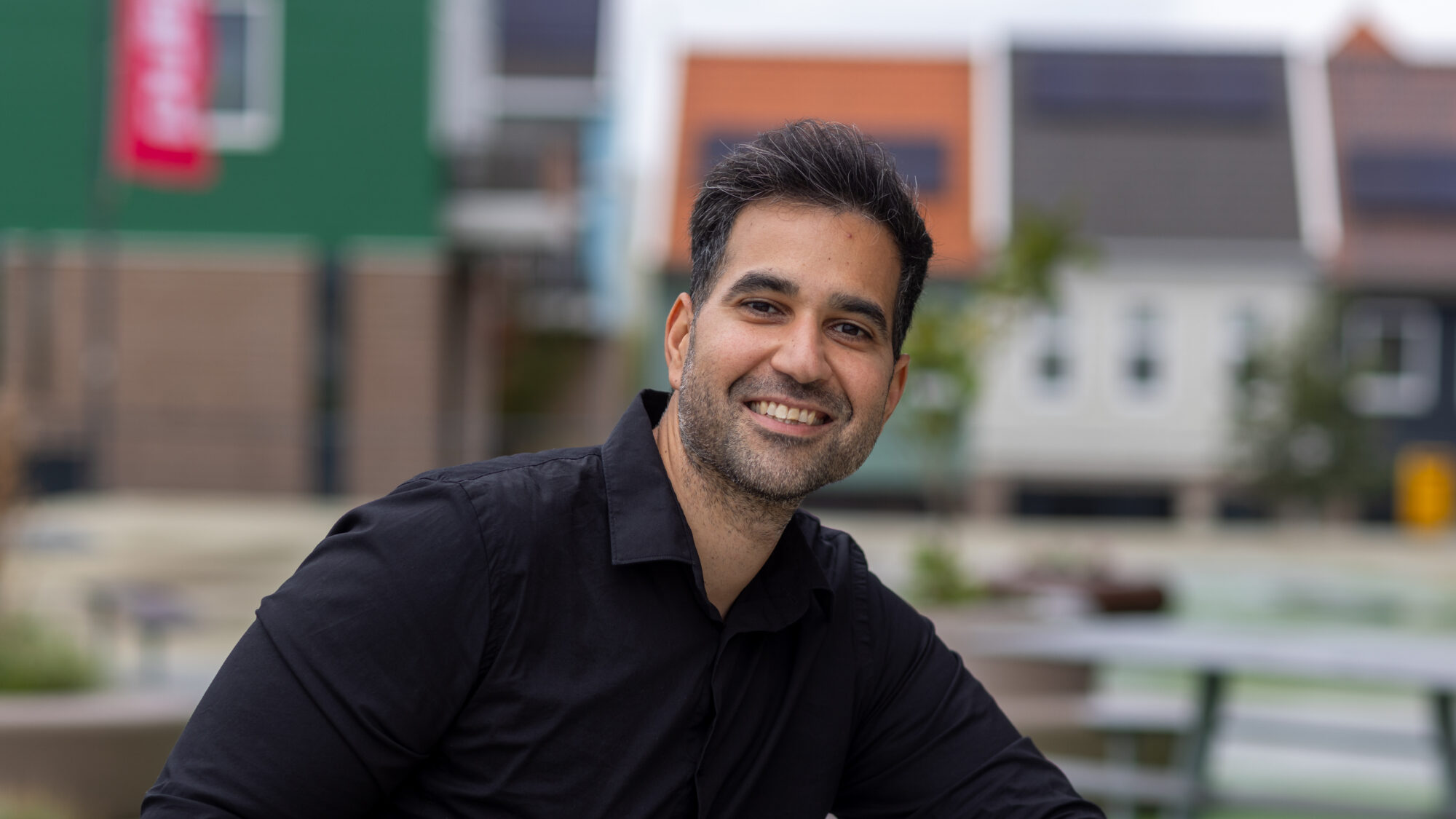
Eighteen years ago, Gökhan Özkan himself was in the audience at an information evening for lateral entrants. The same kind of evening where he tells his story today as a teacher trainer/teacher coach. He was 24, had completed his commercial economics degree a few years earlier and had been working in an office for some time. A neat job, quite nice colleagues, but it wasn't it. ‘It felt stifling,’ he says. ‘I was busy with my keyboard all day and didn't feel like I was contributing anything. You have conversations, you solve things, but you never make a difference. It had no meaning.’
That dissatisfaction coincided with social changes in the Netherlands. ‘The increasing polarisation, the murder of Theo van Gogh, discussions about integration, the harsh headlines. In the office, news from newspapers like the Telegraaf was shared all day long. I no longer wanted to stay in that bubble. I no longer wanted to be on the sidelines, but in the middle of society.’
Vocation
Gökhan visited a job fair and got talking to someone from Compaen VMBO in Zaandam. ‘Right after that job fair, I was allowed to join them for a day and was eager to. To do it myself. Shortly afterwards, everything fell into place. An economics teacher dropped out and Gökhan volunteered to replace him. I got the chance to help these students get the knowledge they needed,’ he says. I am still grateful for that.‘ Gökhan stresses that his drive to enter teaching was not just about social changes. ’Yes, that certainly played a part, but for me it was mainly about making meaning. About making an impact. About feeling that you can change something in education. By the way we talk to students, what we expect from them, how we see them.‘
In the deep
His first day was unforgettable. ‘I had to deal with students with certain problem areas and was thus forced to face the facts that starting from the positive is not always enough. In a class, there are often students from different socio-economic classes and not everyone shares the same norms and values. In other words, one adolescent is not like another, so you also have to differentiate in your pedagogical actions. That realisation has always helped me so far.’
At the heart of society
From day one, Gökhan felt his choice of teaching was the right one. ‘I knew immediately: this is something I can do, this suits me.’ So Gökhan stayed. Twelve-and-a-half years he worked at this largely school, becoming a mentor, supervising classes, organising school parties and camps, and even rigging Berlin trips for around a hundred students. ‘Of course organising that kind of outing needs attention, but at the same time, isn't it great that I just get paid for it?’ Over the years, Gökhan gained increasing trust from colleagues. He experiences the fact that the head of department placed her own son in his mentor class as early as the second year as a huge compliment. ‘That touched me so much. There is no greater compliment.’ As a school trainer, he supervises beginning teachers himself. ‘I begrudge everyone what I got. Supervisors who believe in you, let you make mistakes and take you through how things can be done differently. They were for me what I want to give every day: inspiration.’
‘I wouldn't want to work anywhere else but in education. When I hear people complaining on a birthday or on Sunday in a sports canteen that it is almost Monday again, I consider myself lucky. I have never felt like I had to work since 2008. I get a buck from my students every Monday morning, they compliment me when I wear new shoes, they share their experiences with me. Working with youth is priceless.’